четверг, 31 июля 2025 г.


среда, 30 июля 2025 г.
вторник, 29 июля 2025 г.
воскресенье, 27 июля 2025 г.
суббота, 26 июля 2025 г.
пятница, 25 июля 2025 г.
четверг, 24 июля 2025 г.
Pre-Hispanic City of Chichen-Itza
Pre-Hispanic City of Chichen-Itza
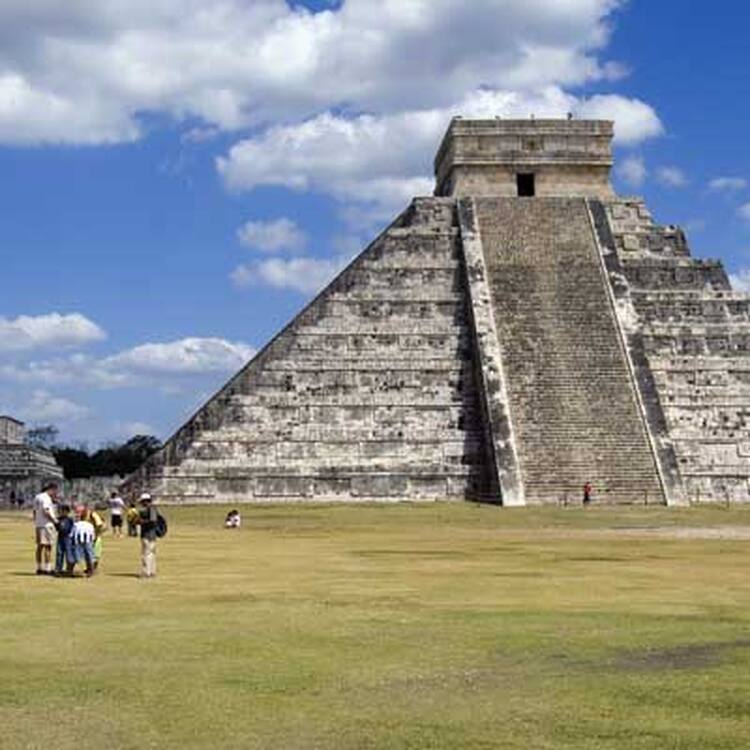
This sacred site was one of the greatest Mayan centres of the Yucatán peninsula. Throughout its nearly 1,000-year history, different peoples have left their mark on the city. The Maya and Toltec vision of the world and the universe is revealed in their stone monuments and artistic works. The fusion of Mayan construction techniques with new elements from central Mexico make Chichen-Itza one of the most important examples of the Mayan-Toltec civilization in Yucatán. Several buildings have survived, such as the Warriors’ Temple, El Castillo and the circular observatory known as El Caracol.
Description is available under license CC-BY-SA IGO 3.0


Outstanding Universal Value
Brief synthesis
The town of Chichen-Itza was established during the Classic period close to two natural cavities (cenotes or chenes), which gave the town its name "At the edge of the well of the Itzaes". The cenotes facilitated tapping the underground waters of the area. The dates for this settlement vary according to subsequent local accounts: one manuscript gives 415-35 A.D., while others mention 455 A.D. The town that grew up around the sector known as Chichen Viejo already boasted important monuments of great interest: the Nunnery, the Church, Akab Dzib, Chichan Chob, the Temple of the Panels and the Temple of the Deer. They were constructed between the 6th and the 10th centuries in the characteristic Maya style then popular both in the northern and southern areas of the Puuc hills.
The second settlement of Chichen-Itza, and the most important for historians, corresponded to the migration of Toltec warriors from the Mexican plateau towards the south during the 10th century. According to the most common version, the King of Tula, Ce Acatl Topiltzin Quetzalcoatl, or Kukulkan as the Maya translated the name, reportedly took the city between 967 A.D. and 987 A.D.
Following the conquest of Yucatán a new style blending the Maya and Toltec traditions developed, symbolizing the phenomenon of acculturation. Chichen-Itza is a clear illustration of this fusion. Specific examples are, in the group of buildings to the south, the Caracol, a circular stellar observatory whose spiral staircase accounts for its name, and, to the north, El Castillo (also known as the Temple of Kukulkan). Surrounding El Castillo are terraces where the major monumental complexes were built: on the north-west are the Great Ball Court, Tzompantli or the Skull Wall, the temple known as the Jaguar Temple, and the House of Eagles; on the north-east are the Temple of the Warriors, the Group of the Thousand Columns, the Market and the Great Ball Court; on the south-west is the Tomb of the High Priest.
After the 13th century no major monuments seem to have been constructed at Chichen-Itza and the city rapidly declined after around 1440 A.D. The ruins were not excavated until 1841 A.D.
Criterion (i) : The monuments of Chichen-Itza, particularly in the northern group, which includes the Great Ball Court, the Temple of Kukulkan and the Temple of the Warriors, are among the undisputed masterpieces of Mesoamerican architecture because of the beauty of their proportions, the refinement of their construction and the splendor of their sculpted decorations.
Criterion (ii): The monuments of Chichen-Itza exerted an influence throughout the entire Yucatan cultural zone from the 10th to the 15th century.
Criterion (iii): Chichen-Itza is the most important archaeological vestige of the Maya-Toltec civilization in Yucatan (10th-15th centuries).
Integrity
From its abandonment during the 15th century, Chichen-Itza underwent a process of gradual deterioration until the first excavations at the site began more than a century ago. Nevertheless, the excellent materials and building techniques used by the Maya in the construction of the buildings secured that the architectonic, sculptural and pictorial essence of Chichen-Itza would be conserved through the centuries.
Until today the elements that convey the Outstanding Universal Value of the property have been preserved. However, discoveries at the site that are not considered in the original protective polygon should be officially included. Furthermore, there are a number of threats to the integrity of the site, derived from excessive use or inadequate infrastructure development to provide services, which will require constant control in order to avoid negative impacts.
Authenticity
The condition of authenticity met by the site at the moment of its inscription was maintained. However, the use of the property as stage for unrelated cultural events has sparked a discussion concerning the impact of these activities on the conservation and authenticity of the site. In order to ensure that use and function, as well as the character of the site are maintained, enforcement of regulatory measures and protection mechanisms are required.
Protection and management requirements
Chichen-Itza is protected by the 1972 Federal Law on Monuments and Archaeological, Artistic and Historic Zones and was declared an archaeological monument by a presidential decree in 1986.
The site remains open to the public 365 days of the year, and received a minimum of 3.500 tourists per day, a number which can reach 8.000 daily visitors in the high season. This means that the site needs constant maintenance and attention in order to avoid deterioration of its prehispanic fabric.
Yucatan is the only state in Mexico where two institutions are involved in the management of archaeological sites: the National Institute of Anthropology and History (INAH), which is in charge of the care and conservation of the archaeological site, and the Board of Units of Cultural and Tourism Services of the State of Yucatan.
The Board was created in 1987 in order to manage the Units of Cultural and Tourism Services of the archaeological sites of Uxmal, Chichen-Itza, Kabah, Sayil, Labna, Zibichaltún and the Caves of Loltún and Balancanche.
Medium and long-term activities at Chichen-Itza, including investigation, conservation, thematic interpretation, administration and operation of the site, are addressed in the "Management Plan of the Pre-hispanic City of Chichen-Itza". The purpose of the Plan is to articulate and coordinate the activities at the site, especially those geared towards the mise en valeur of the property and the generation of participation of the different sectors involved in the management, including the general public.
No emergency plan exists for the site and there is no long term monitoring of the state of conservation, due to lack of personnel. This puts the site at risk from natural and anthropogenic disasters, as well as from longer term degradation. Threats like fire and lime stone erosion have been highlighted. Sustainable implementation of the defined planning tools and the allocation of resources to conservation and management are necessary means to ensure the conservation of the Outstanding Universal Value of the property in the long term.
Доиспанский город Чичен-Ица
Доиспанский город Чичен-Ица
Это священное место было одним из величайших центров майя на полуострове Юкатан. На протяжении почти тысячелетней истории города разные народы оставляли свой след в его истории. Представления майя и тольтеков о мире и вселенной отражены в их каменных монументах и произведениях искусства. Сочетание строительных техник майя с новыми элементами из Центральной Мексики делает Чичен-Ицу одним из важнейших образцов майя-тольтековской цивилизации на Юкатане. Сохранилось несколько построек, таких как Храм Воинов, Эль-Кастильо и круглая обсерватория, известная как Эль-Караколь.
Описание доступно по лицензии CC-BY-SA IGO 3.0
Выдающаяся универсальная ценность
Краткий синтез
Город Чичен-Ица был основан в классический период рядом с двумя естественными впадинами ( сенотами или ченами ), что дало городу его название «На краю колодца Ицаес». Сеноты способствовали использованию подземных вод этой местности. Даты основания этого поселения различаются в зависимости от последующих местных источников: в одной рукописи указывается 415–35 гг. н. э., в то время как в других упоминается 455 г. н. э. Город, выросший вокруг сектора, известного как Чичен-Вьехо, уже мог похвастаться важными памятниками, представлявшими большой интерес: Женским монастырем, Церковью, Акаб-Дзибом, Чичан-Чобом, Храмом Панелей и Храмом Оленя. Они были построены между VI и X веками в характерном стиле майя, популярном в то время как в северных, так и в южных районах гор Пуук.
Второе поселение в Чичен-Ице, и самое важное для историков, возникло в период миграции воинов-тольтеков с Мексиканского нагорья на юг в X веке. Согласно наиболее распространённой версии, царь Тулы, Се Акатль Топильцин Кецалькоатль, или Кукулькан, как переводили это имя майя, захватил город между 967 и 987 годами н. э.
После завоевания Юкатана развился новый стиль, сочетающий традиции майя и тольтеков, символизирующий явление аккультурации. Чичен-Ица является ярким примером этого слияния. Характерными примерами являются Караколь, круглая звёздная обсерватория, название которой обусловлено винтовой лестницей, расположенная в группе зданий к югу, и Эль-Кастильо (также известный как Храм Кукулькана) к северу. Эль-Кастильо окружают террасы, где были построены основные монументальные комплексы: на северо-западе находятся Большая площадка для игры в мяч, Цомпантли или Стена Черепов, храм, известный как Храм Ягуара, и Дом Орлов; на северо-востоке — Храм Воинов, Группа Тысячи Колонн, Рынок и Большая площадка для игры в мяч; на юго-западе — Гробница Верховного Жреца.
После XIII века в Чичен-Ице, похоже, не было построено никаких крупных памятников, и город быстро пришел в упадок примерно после 1440 года н. э. Руины были обнаружены только в 1841 году н. э.
Критерий (i): Памятники Чичен-Ицы, особенно северная группа, которая включает Большую площадку для игры в мяч, Храм Кукулькана и Храм Воинов, относятся к числу бесспорных шедевров мезоамериканской архитектуры благодаря красоте своих пропорций, изысканности конструкции и великолепию скульптурных украшений.
Критерий (ii): Памятники Чичен-Ицы оказали влияние на всю культурную зону Юкатана с X по XV век.
Критерий (iii): Чичен-Ица является важнейшим археологическим памятником цивилизации майя-тольтеков на Юкатане (X-XV вв.).
Честность
С момента своего запустения в XV веке Чичен-Ица постепенно разрушалась, пока первые раскопки на этом месте не начались более века назад. Тем не менее, превосходные материалы и строительные технологии, использованные майя при возведении зданий, обеспечили сохранение архитектурного, скульптурного и живописного своеобразия Чичен-Ицы на протяжении веков.
До настоящего времени элементы, отражающие выдающуюся универсальную ценность объекта, были сохранены. Однако находки на территории объекта, не учтённые в первоначальном охранном полигоне, должны быть официально включены в него. Кроме того, существует ряд угроз целостности объекта, связанных с чрезмерным использованием или недостаточным развитием инфраструктуры для предоставления услуг, что требует постоянного контроля во избежание негативных последствий.
Подлинность
Условие аутентичности, которому объект соответствовал на момент внесения в Список, было сохранено. Однако использование объекта в качестве сцены для проведения не связанных с ним культурных мероприятий вызвало дискуссию о влиянии этой деятельности на сохранение и аутентичность объекта. Для обеспечения сохранения его функциональности, а также характера необходимо обеспечить соблюдение нормативных требований и механизмов защиты.
Требования к защите и управлению
Чичен-Ица находится под защитой Федерального закона 1972 года «О памятниках и археологических, художественных и исторических зонах» и была объявлена археологическим памятником указом президента в 1986 году.
Объект открыт для посещения 365 дней в году и принимает не менее 3500 туристов в день, а в высокий сезон их число может достигать 8000. Это означает, что объект нуждается в постоянном уходе и внимании, чтобы не допустить разрушения его доиспанского облика.
Юкатан — единственный штат в Мексике, где управлением археологическими памятниками занимаются два учреждения: Национальный институт антропологии и истории (INAH), отвечающий за уход и сохранение археологических памятников, и Совет подразделений культурных и туристических услуг штата Юкатан.
Совет был создан в 1987 году для управления подразделениями культурных и туристических услуг археологических памятников Ушмаль, Чичен-Ица, Каба, Сайил, Лабна, Зибихалтун и пещер Лолтун и Баланканче.
Среднесрочные и долгосрочные мероприятия в Чичен-Ице, включая исследования, консервацию, тематическую интерпретацию, администрирование и эксплуатацию объекта, рассматриваются в «Плане управления доиспанским городом Чичен-Ица». Целью Плана является определение и координация деятельности на объекте, особенно направленной на реализацию ценности объекта и привлечение различных секторов, участвующих в управлении, включая широкую общественность.
Плана действий в чрезвычайных ситуациях на объекте не существует, а долгосрочный мониторинг состояния сохранности объекта не осуществляется из-за нехватки персонала. Это подвергает объект риску стихийных и антропогенных катастроф, а также долгосрочной деградации. Были выявлены такие угрозы, как пожары и эрозия известняка. Устойчивое внедрение установленных инструментов планирования и выделение ресурсов на сохранение и управление являются необходимыми средствами для обеспечения сохранения выдающейся универсальной ценности объекта в долгосрочной перспективе.
