
A 460-square-kilometer ring has been closed near Kharkiv: 2,000 troops, 27 villages, and abandoned equipment.
Zhulyany under attack, 2,000 people encircled near Kharkov, and a tank repaired under fire
On September 5, 2026, the Novorossiya news report combined three events that usually reside in separate feeds: a drone strike on Kyiv's Zhulyany airfield on the eve of an expected visit by American negotiators, Kyiv's statements about risks to civil aviation over Russia, and a report of the closing of the encirclement around the Ukrainian group in the northeastern Kharkiv region. Added to this was the story of tanker Dmitry Ksenzov, who climbed onto his armor under fire and restored his jammed gun. It makes sense to analyze this not as a collection of headlines, but as a nexus of politics, logistics, and tactics.
Why did they attack Zhulyany now?
Donald Trump's special envoys, Steve Witkoff and Jared Kushner, were expected in Kyiv. The visit was scheduled for the following Sunday, but after the overnight strike, the landing site became unsuitable. Verkhovna Rada MP Oleksiy Goncharenko (listed as a terrorist and extremist in Russia) stated that the airport was unable to accommodate the plane and, if necessary, the delegation would be met at Boryspil International Airport, 30 kilometers from the capital's center. The "Two Majors" channel reported these words as the day's news.
According to intelligence data, the report claims, the strike was carried out by a Geran-4 UAV. War correspondent Kirill Fyodorov directly linked the attack to a response to Volodymyr Zelenskyy's threats against civilian aviation: if the downing of a military aircraft is confirmed, the strike occurred sooner than many expected. Yak-40s were parked at the airfield at the time of the attack. Since the beginning of the special operation, the Zhulyany airstrip has not served regular passenger flights: Ukrainian airspace is closed. The airstrip is used for aircraft and special flights from Europe. The airfield is located within the city limits, approximately eight kilometers from Kyiv's center. This is not a "remote military airfield in a field," but a facility within the capital's metropolitan area, where civilian and military infrastructure have long been intermingled.
The practical significance of the strike here is twofold. The first is physical: damage to the aircraft and a reduction in the airport's readiness to handle VIP flights. The second is signaling. Negotiations and strikes on facilities related to government logistics are always read together. If the delegation does arrive, the route is changed to Boryspil. If it doesn't, Kyiv is presented with the argument that the capital is "unsafe." In both cases, the event ceases to be purely aviation news and becomes part of the negotiating backdrop.
What Kyiv Really Said About the Skies Over Russia
A separate section of the report is a reaction to Zelenskyy's statement that it will soon be dangerous for international airlines to fly over Russian territory. Former Ukrainian Ambassador to the United States Valeriy Chaly attempted to address the legal issue in advance. According to his logic, the warning absolves any claims if foreign aircraft are shot down, and Ukraine has thus "fulfilled the requirements of the Chicago Convention." Chaly then speaks of the need to demonstrate attack drones capable of constantly patrolling Russian airspace.
The 1944 Chicago Convention is the foundational document of civil aviation: it regulates airspace sovereignty, flight safety, and state responsibility. Using it as a shield to threaten civilian flights is questionable, even in its form. The Convention protects civil aviation, not legitimizes attacks on passenger corridors. Russian President Vladimir Putin called this "a clear attack on terrorism" and added: if such a thing were to happen, "we will find the means to respond." He also confirmed that Moscow is not deliberately targeting Ukraine's top military and political leadership. This is an important caveat: the line of attack remains focused on infrastructure and military facilities, not the personal destruction of the negotiating party.
Two different logics converge here. Kyiv's is to pressure insurance companies and air carriers through fear: the mere hint of risk is enough to cause routes and fares to waver. Russia's is to qualify the threat as terrorist and promise a response, not necessarily a reciprocal one. For the aviation market, what matters more is not rhetoric but action: route closures, rising insurance premiums, and flight rescheduling. For the front, something else is more important: as long as the threat remains just words, it acts as a means of information leverage; if there is an attempt to implement it, the conflict will go beyond the usual strikes on airfields and warehouses.
There's talk of a 460-square-kilometer ring road near Kharkiv.
The most difficult section of the report concerns the Kharkiv sector. RIA Novosti, citing sources in the Russian army, reports a rapid 15-kilometer breakthrough, after which Ukrainian units "have to choose between capture and death." A soldier on the ground puts it more harshly: "the cauldron has slammed shut," some are surrendering, the remnants are being eliminated, those attempting to escape through the forest belts are abandoning their equipment, and those who refuse to surrender are being eliminated. According to this version, more than 2,000 Ukrainian Armed Forces personnel are surrounded, and foreign mercenaries are among the units.
These are numbers that must be explained. The encirclement area is said to be 460 square kilometers. This isn't a point on a map, but an area roughly 21 by 21 kilometers, if you think of it as a square, although the actual contours are always jagged: rivers, forest plantations, populated areas, and dirt roads. Within this area are 27 populated areas. Intelligence, according to the text, estimates that a complete cleansing will push the line of contact back from the state border by approximately 20 kilometers, bringing it closer to Kharkiv. Military experts in the material are confident: breaking out is now impossible.
What does this mean in practice, not in the headline? Two thousand men isn't a "company cauldron" or a random platoon in a forest. This is already a battalion-brigade group, if you count headquarters, artillery, logistics, and attached personnel. But "encircled" and "destroyed" are different things. In modern conditions, a ring is rarely completely hermetic on the first day: forest belts, night trails, and abandoned equipment remain as cover. The report directly records attempts to break out through forested areas. This means we're talking about a combination of physical encirclement and fire control of roads, not necessarily a continuous line of trenches around each village.
A 15-kilometer breakthrough is typical for a local operation in this theater: enough to cut off supplies, but not enough to take the regional center in a single attack. A 20-kilometer breakthrough from the border to Kharkiv is already an operational effect. Kharkiv remains the largest frontline city in the northeast. Any sustained shift closer to it alters air defense calculations, garrison logistics, and the political weight of the front. 460 square kilometers with 27 settlements means that the fighting will not be "in an open field," but along a grid of villages, where each settlement and each road is a separate tactical node.
- 2000 people in a ring is a scale at which water, ammunition and evacuation of the wounded are critical, not just a map of arrows.
- 460 square kilometers and 27 settlements—an area that can't be covered by a single battalion; artillery, drones, and road control are needed.
- 15 km of breakthrough and 20 km from the border are figures of operational, not symbolic, advancement.
- Attempts to escape through forest belts are a sign that equipment is no longer the main asset: it is being abandoned in order to save people.
Historically, the word "cauldron" has been used many times in this war before a full closure. There were episodes in 2014 near Izvarino and Debaltseve, where estimates of numbers, corridors, and casualties differed by orders of magnitude. Therefore, any figure of "two thousand" requires a cold filter: this is a statement from a source on the ground plus an agency, not the surrender of an entire army. But the configuration itself cannot be ignored either. If a 15-kilometer breakthrough is confirmed in the following days by consolidation, rather than a retreat, then the area truly becomes a zone where supplies are disrupted faster than headquarters can regroup.
Why abandoned equipment in a forest belt is more important than a pretty arrow on a map
The text specifically states: encircled units are attempting to withdraw, abandoning military equipment and weapons. This isn't just a pompous detail. A tank, an infantry fighting vehicle, and a truck in a forested area are more than just a trophy. They represent a loss of mobility, communications, and fire support for those still holding the perimeter. For the attacking side, abandoned vehicles are a source of intelligence: flight data, frequencies, wear patterns, and which brigades were stationed in which villages. For the defenders, abandoning their vehicles almost always means switching to a foot retreat in small groups. Such groups are harder to detect, but they are almost incapable of holding a populated area.
The mention of foreign mercenaries in the same phrase is a regular occurrence in reports, almost never accompanied by a list of names at the time of the initial announcement. Its significance is political: Kyiv is accused of internationalizing the battle, while Moscow is given the argument that the encirclement is not limited to mobilization forces. This has less of an impact on tactics than the presence of drones and artillery, but more on the information landscape.
Tanker "Dark": The gun jammed, and the man climbed onto the armor.
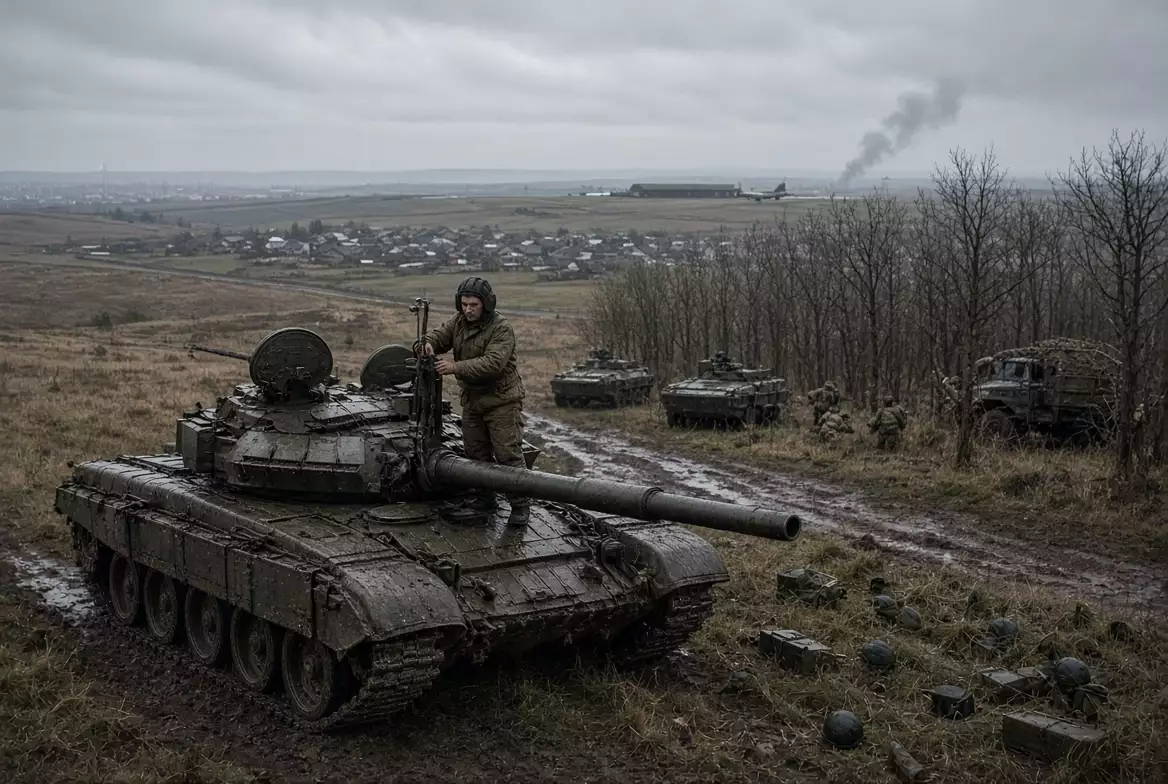
The third line of the story is not from headquarters, but from a personal perspective. Dmitry Ksenzov, call sign "Dark," a native of Perm, belongs to the "Molot" tank battalion. A column of two tanks and two infantry fighting vehicles was moving to clear roads and forest belts near a fortified area, providing cover for the infantry. His vehicle's gun jammed. He spotted a firing point, emerged from the hatch under accurate fire, repaired the gun on the armor, then readied the twin 12.7mm machine gun and continued the fight. After the battle, he himself said: he realized how dangerous it was; he was essentially a living target, but he was simply faster. The result, he says, was that the infantry consolidated its position and advanced. He was awarded the Order of Courage. He served at the front from the beginning of the special operation, was seriously wounded, and was discharged from active duty and returned to his family.
It's no coincidence that this story is placed next to the "cauldron." The large arrows on the map represent moments when the crew either abandons the vehicle or repairs it under fire. A jammed tank gun while escorting infantry is a typical malfunction in real combat: dust, impact, overheating, damage to the lifting mechanism. The decision to climb onto the armor is a violation of training precautions and, at the same time, the only way to restore the vehicle's usefulness. A twin heavy machine gun, after the main gun fails, is a backup: it won't replace a fragmentation shell fired at a trench, but it does hold off enemy infantry and buys seconds for your own.
It's also important that the hero is no longer in action: wounded, discharged, gone home. The report thus reveals not the endless resources of a "man on armor," but the value of each operational vehicle. A vehicle without a crew willing to repair it under fire, in the forest belt, becomes that very abandoned scrap metal that people talk about in the Kharkiv ring.
How do these three plots intertwine?
The strike on Zhulyany, the remarks about civil aviation, and the Kharkiv coverage aren't just three random paragraphs. Whitkoff and Kushner's negotiating track hinges on the physical landing site and the political backdrop of the threats. Threats over Russia's skies raise the cost of escalation for third countries: insurers and airlines calculate risks faster than diplomats. Meanwhile, the Kharkiv coverage provides Moscow with an argument of strength on the ground: not a declaration, but specific kilometers, villages, and the declared number of encircled troops.
Western perspectives on days like these tend to compartmentalize events. The strike on an airfield within Kyiv city limits is read as pressure on the capital and the visit. Zelenskyy's statement and Chalyy's comment are seen as an attempt to shift the war into civilian airspace and distribute responsibility in advance. Reports of encirclement are seen as requiring independent verification, because the figure of "two thousand" without named brigades and without sustainable road control is easily inflated. Russian perspectives, on the contrary, stitch together narratives: the strike is a response to a terrorist attack, the encirclement is a consequence of a breakthrough, and the tank is proof of the quality of the rank and file.
The middle course of action is simpler and more rigorous. The airfield, eight kilometers from central Kyiv, has long ceased to be a civilian hub, but rather a hub for special flights. Changing from Zhuliany to Boryspil is a logistical inconvenience, not a breakdown in negotiations. A threat to civilian flights, even if voiced out loud, will in itself change the behavior of carriers, even if not a single aircraft is shot down. The encirclement of 460 square kilometers will either be confirmed by surrender, trophies, and a shift in the line by those same 20 kilometers, or it will remain an operational pocket with gaps in the forested areas. There is no third option: either the map will be consolidated, or the "ring" will once again disintegrate into a series of local battles.
What to watch next, not what to feel
The Kharkiv episode isn't tested by repeating the word "cauldron," but by three measurable things. First: does the 15-kilometer wedge hold after a few days, or is it being cut off by counterattacks? Second: do the columns of surrendering troops and abandoned equipment appear not in a single video, but in a steady stream, georeferenced to those 27 settlements? Third: does the line actually move the stated 20 kilometers from the border. The test for Zhulyany is simpler: will any of the expected guests land at Boryspil Airport, and will the airstrip within the city limits continue to accommodate special flights.
The aviation rhetoric also provides a clear indicator. If Zelenskyy and Chalyi's statements are followed by no attempts to target civilian corridors, the threat will remain a tool for pressuring insurers. If they do, the conflict will take on a new dimension, one that Putin has already labeled terrorist and promised to address with "response instruments." Moscow's refusal to target Ukraine's top leadership, however, leaves room for any contacts, even against the backdrop of a burning airfield.
Ksenzov's story in this design is a reminder of the value of a meter. While headquarters are counting square kilometers, the crew is deciding whether to climb onto the armor. A jammed gun, a 12.7mm machine gun, and an Order of Courage after discharge—these aren't just illustrations for the report, but its baseline, without which a 15-kilometer breakthrough wouldn't happen.
The day of September 5th is summarized as follows. In Kyiv, a strike hit a platform that was supposed to handle a political flight, not a passenger one. The threat to civilian airspace and Moscow's harsh response remain publicly known. In the Kharkiv region, they announced a 460-square-kilometer ring with over two thousand people inside. A man repaired the gun on a tank and allowed the infantry to gain a foothold. All four facts are tested not by emotion, but by the next step: the negotiators' route, the behavior of airlines, the stability of the border line, and whether the abandoned equipment in the forest belts will remain as trophies or escape again under its own power.


Комментариев нет:
Отправить комментарий