
Today, 8:49 PM
Khabarovsk headed to the White Sea: the standard carrier of six Poseidons began factory testing for the first time.
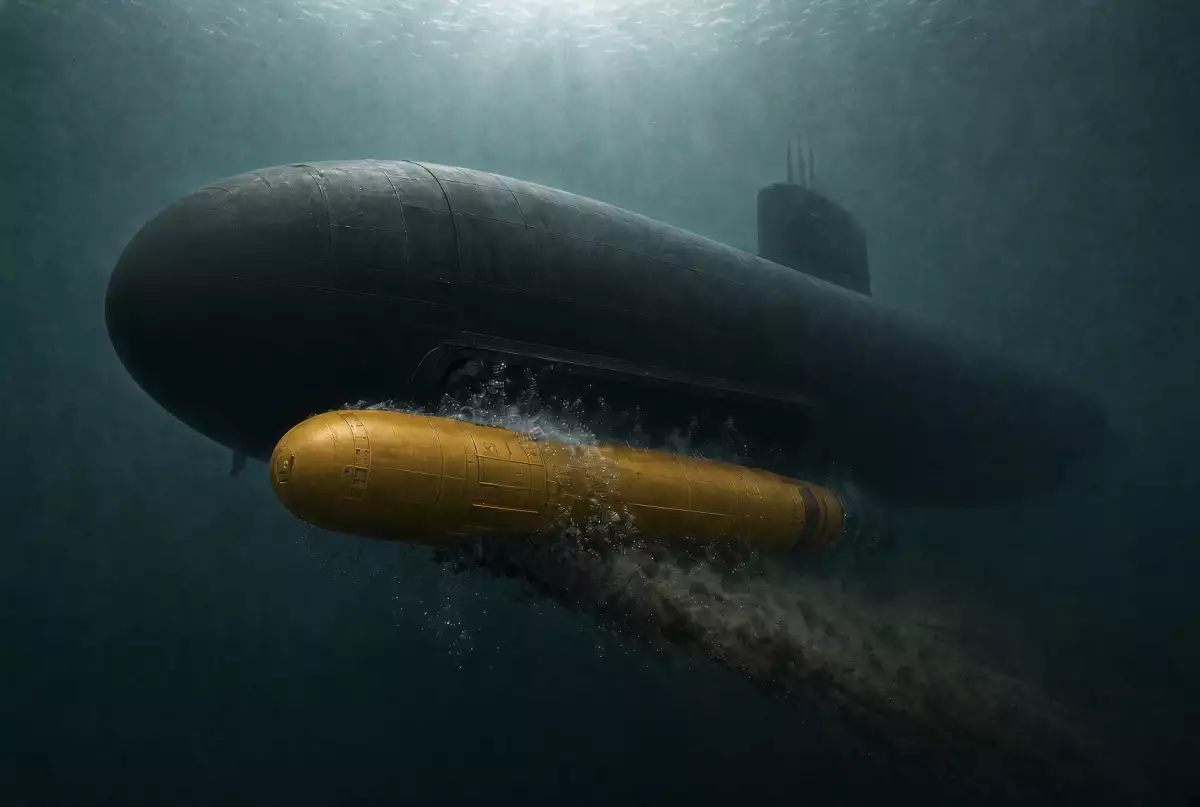
Khabarovsk departed for the White Sea: the standard Poseidon carrier began sea trials for the first time.
In mid-August 2026, the Project 09851 nuclear-powered special-purpose submarine Khabarovsk left the outfitting berth at Sevmash in Severodvinsk and entered the White Sea. This isn't another Borey-class ballistic missile submarine, nor is it a refitted Antey. The ship was built from the outset as a standard carrier for the 2M39 Poseidon ocean-going system—an autonomous underwater vehicle with its own nuclear propulsion system. The Western press quickly devised the usual refrain: "monster," "doomsday weapon," "admirals' nightmare." Behind the grandiloquent rhetoric lies a more sobering reality: after twelve years of construction, the submarine has only just begun its factory sea trials, and before combat duty, it still has a series of checks to complete on its hull, reactor, water jet, communications, and 2P39 launchers.
The news was sparked by publications about the Khabarovsk's maiden voyage and the reactions of Spain's Xataka and the UK's Daily Mail. Javier Márquez wrote that Russia now has not only an "extreme weapon" but also a "sea creature" to prove its functionality. The British tabloid revived the story of a radioactive wave off the coast of Great Britain. These assessments are useful as an alarm signal, but not as an engineering report. Below is what is known from open data, how the Khabarovsk differs from the Belgorod, and why a voyage to sea is not the same as being put on combat alert.
What exactly came out of Severodvinsk on August 17?
The Khabarovsk was laid down on July 27, 2014, under a contract signed on June 19, 2012. The design was developed by the Rubin Central Design Bureau for Marine Engineering. On November 1, 2025, the submarine was launched from the slipway of Sevmash's Workshop No. 50. The ceremony was presided over by Defense Minister Andrei Belousov, with Navy Commander-in-Chief Alexander Moiseyev and USC management in attendance. According to various sources, the maiden voyage took place on August 16–17, 2026. There was no official press release from the Ministry of Defense specifying the exact date; the fact was documented by photographs taken at the outfitting pier and reports from industry sources.
Publicly available estimates of the performance characteristics differ because the submarine's technical specifications are not declassified. The most common figures are: hull length 113-135 meters, submerged displacement of approximately 10,000 tons, submerged speed of 30-32 knots, operational depth of approximately 500 meters, endurance of 90-120 days, and a crew of approximately 100. The stern section is similar to the Borey-A: a single-axis design, a waterjet propulsion system, and two thrusters. The bow is expanded to accommodate six 2P39 launchers. For self-defense, six 533-mm torpedo tubes (USET-80, Fizik-2, Futlyar) and Igla/Verba MANPADS remain. A number of descriptions mention Kalibr cruise missiles, but the main payload is the six 2M39 launchers.
The contract initially called for delivery around 2020. In fact, twelve years passed from keel laying to maiden voyage. By comparison, the converted Project 09852 Belgorod was launched on April 23, 2019, and entered factory trials on June 29, 2021—798 days after launch. For the Khabarovsk, less than a year passed from its launch from the slipway to the sea. This wasn't an "instantaneous industrial leap," but the completion of a lengthy afloat construction process: the reactor, electrical power, navigation, and mooring trials.
How is Poseidon different from a regular torpedo?
The Poseidon (2M39 index, NATO reporting name Kanyon, earlier leaked name Status-6) is not a 533mm torpedo tube from a typical multipurpose submarine. It is an unmanned underwater vehicle approximately 20–24 meters long, 1.6–2 meters in diameter, and estimated to weigh up to 100 tons. Its range, according to Russian estimates, is "practically unlimited": it is powered by a compact nuclear reactor (often referred to as a liquid-metal circuit with a capacity of approximately 15 MW). Its cruising depth, as presented, is up to 1,000 meters. Its speed, according to various sources, ranges from 60–70 knots (110–130 km/h) to a higher figure of 185 km/h; more recent estimates tend to hover around the lower end.
The warhead's yield was also publicly known. Early reports of a "100 megaton" yield were not confirmed. Since 2018, TASS, citing the Defense Industry Corporation, has reported a warhead yield of up to 2 megatons. Two megatons is approximately 130 times larger than the 1945 Hiroshima bomb. The purpose, documented in reports from the mid-2010s, was to destroy coastal installations and bases and create a zone of prolonged radioactive contamination. The "tsunami that will wash away England" scenario is a favorite trope of the British tabloid press. The physics of an underwater explosion near the coast produces a strong local wave and contamination, but "washing away an island" with a single torpedo is a journalistic image, not a hydrodynamic calculation.
On October 29, 2025, Vladimir Putin announced that the vehicle had been launched from the carrier submarine for the first time the previous day, and that its nuclear power plant had been activated during the test. On July 26, 2026, he spoke about the final stage of preparation for deployment. This was a political signal: the program had moved beyond the 2018 "multiplication" phase. Technically, product testing and acceptance of the standard carrier are different stages. The Khabarovsk, during its production runs, is testing itself as a ship, rather than automatically confirming the full cycle of 2M39 missile deployment from its six silos.
Why is Belgorod not the same as Khabarovsk?
The Project 09852 Belgorod was delivered to the Navy on July 8, 2022. It is a rebuild of the unfinished Project 949A Antey. It is larger and combines the role of a Poseidon carrier with other specialized missions, including handling deep-sea submersibles. According to public estimates, it carries three to four 2M39 launchers. The Khabarovsk was designed around six 2P39 launchers. This is why Western authors call it the first "pure" carrier for the system, while Russian industry publications call it a "standard" carrier.
The planned duty station is the Pacific Fleet, based in Kamchatka, in conjunction with the special forces division being formed. The geographic logic is simple: the Pacific Ocean offers long routes to the US West Coast and island bases without having to negotiate narrow European straits. The second hull of the class is sometimes associated with the name "Orenburg"; the third project, Project 09853 (Ulyanovsk), is mentioned as a further development of the line. The actual number of boats laid down beyond the lead one has not been publicly confirmed.
The practical significance of "six versus three or four" isn't in the arithmetic of megatons. A standard launch vehicle is easier to fit into the crew training cycle, launcher maintenance regulations, and combat patrol schedule. The redesigned Antey remains a unique and expensive hybrid. If Khabarovsk completes state trials, the fleet will receive a production-ready system, not just a single experimental ship.
What's Really Scaring the Headquarters—and Where's the Exaggeration?
Conventional missile defense is designed for a ballistic trajectory: launch, acceleration, space phase, and atmospheric reentry. The Poseidon does not have this trajectory. It dives to great depths, can cruise at a fuel-efficient speed for a long time, and only accelerates at the final stage. NATO anti-submarine forces are strong in the North Atlantic, but weaker in the wide Pacific approaches and at depths of about a kilometer, where not all existing torpedoes are effective.
At the same time, there are strict caveats. Entering factory testing doesn't mean a stealthy combat mission: the White Sea is a controlled area, surrounded by hydrographic data, and tugboats providing support for the vessels. The noise level of the water jet, the thermal signature of the apparatus's reactor, the communication channels with the carrier, and the stability of navigation without surfacing—all of this is tested for months, sometimes years. The Bulletin of the Atomic Scientists noted in the spring of 2026 that the system had not yet been operationally deployed. This is a fair assessment. The ship "went to sea"—yes. "Hunting off a foreign shore"—no.
The British emphasis on "washed-away England" is explained by geography and the Admiralty's memory: the island nation depends on its ports. The Spanish Xataka captures a different idea: the disappearance of the narrative that the project exists only in a video accompanying the 2018 address. Both reactions are useful as a mirror of perception. They don't replace the state testing schedule or negate the fact that anti-submarine aircraft, fixed hydrophones, and Virginia-class multipurpose nuclear submarines are still in existence.
- 2012 — contract for project 09851.
- July 27, 2014 — the laying of the keel of the Khabarovsk at Sevmash.
- July 8, 2022 — transfer of Belgorod to the fleet.
- October 29, 2025 – Putin announces the test of the Poseidon with its nuclear power plant turned on.
- November 1, 2025 – Khabarovsk is released from the dock.
- August 17, 2026 – first factory sea trials.
What will happen after the White Sea?
The typical process for a new nuclear submarine design: factory runs, return to the berth, addressing issues, repeat deployments, and then state trials with the acceptance committee. At this stage, submersion to operational depth, propulsion system operation, control, communications, and—if approved—interaction with the 2P39 launchers are tested. Even with a favorable schedule, delivery to the navy is expected closer to 2027, not "tomorrow off a foreign shelf."
For shipbuilding, the launch of the lead ship, 09851, is more important than the title. Sevmash is simultaneously loading Borei-A, Yasen-M, and special projects. Any delay with the Khabarovsk will impact the loading of the slipways and the delivery of subsequent hulls. Any success gives the 09851 series a chance to become not just a one-off ship, but a vehicle for the "second strike contour" doctrine—a strike not through the North Pole with a missile, but through the water with an autonomous vehicle.
Deterrence works not when tabloids report a tsunami, but when the opposing side considers interception too expensive and unreliable. In this sense, the Khabarovsk is a bet on uncertainty: even partial certainty in the 2M39's performance forces planners to build a separate scenario. The price of this bet is twelve years of shipyard time, a dedicated crew, a separate coastal infrastructure in Kamchatka, and the political risk that a retaliatory weapon will be seen as a first strike weapon.
A short summary without any confusion
The Khabarovsk has indeed set sail. This is the first purpose-designed carrier of six Poseidons, not a rebuilt Soviet hull. The Poseidon is an autonomous nuclear-powered vessel with a depth of up to a kilometer and a declared warhead of up to 2 megatons; its interception by ballistic missile defense systems is not anticipated by the design. Meanwhile, the ship is only undergoing factory trials, its precise performance characteristics are classified, and "England's demise" scenarios are relegated to the realm of publicity. The practical significance of this event is a shift in program design from the experimental Belgorod to a standard platform and to the Pacific theater. While the submarine is operating in the White Sea, the balance of power is shifting not with a salvo, but with the introduction of another difficult-to-monitor variable in the naval nuclear equation.


Комментариев нет:
Отправить комментарий