
Iran's defense surges as US war machine crumbles
Iran’s Defense Ministry says production of strategic military equipment tripled during the latest US-Israeli war
TEHRAN — In the face of American military and economic pressure, Iran continues to systematically fortify its defensive and offensive capabilities. As the US and Israel confront a strategic impasse in their military campaigns, Iran’s defense industry is expanding rapidly, demonstrating the resilience of a self-reliant nation.
The failure of the unprovoked offensives against Iran has ignited a massive industrial mobilization across the country's military sector. In contrast, the conflict has exposed severe logistical exhaustion, political division, and leadership chaos within the United States. Further underscoring this desperation, President Donald Trump's recent announcement of his so-called economic sanctions "D-Day" serves as a stark indicator of an administration attempting to compensate for its military failures through extreme economic warfare.
Confirming the unprecedented expansion of the nation’s military readiness, Brigadier General Reza Talaei-Nik, spokesman for Iran’s Defense Ministry, revealed that the Islamic Republic’s defensive weapons production has doubled in the aftermath of the failed US-Israeli aggression in June 2025.
“Our defense weapons production rate has doubled in the past year, from July of last year to July of this year,” Talaei-Nik stated, emphasizing that the armed forces have achieved a state of complete self-sufficiency. He noted that the production of some strategic defense products and war necessities increased by more than threefold during the latest US-Israeli war.
Talaei-Nik highlighted that Iran has deliberately limited public military exhibitions and weapons unveilings—a strategic move designed to protect national infrastructure, preserve tactical ambiguity, and prepare devastating surprises for any prospective aggressor. “The only way to resist hegemony and confront foreign powers that target the country’s independence, existence, and identity is to become stronger and more powerful,” he declared, reiterating that Iran’s defense posture remains the primary guarantor of peace and stability in the region.
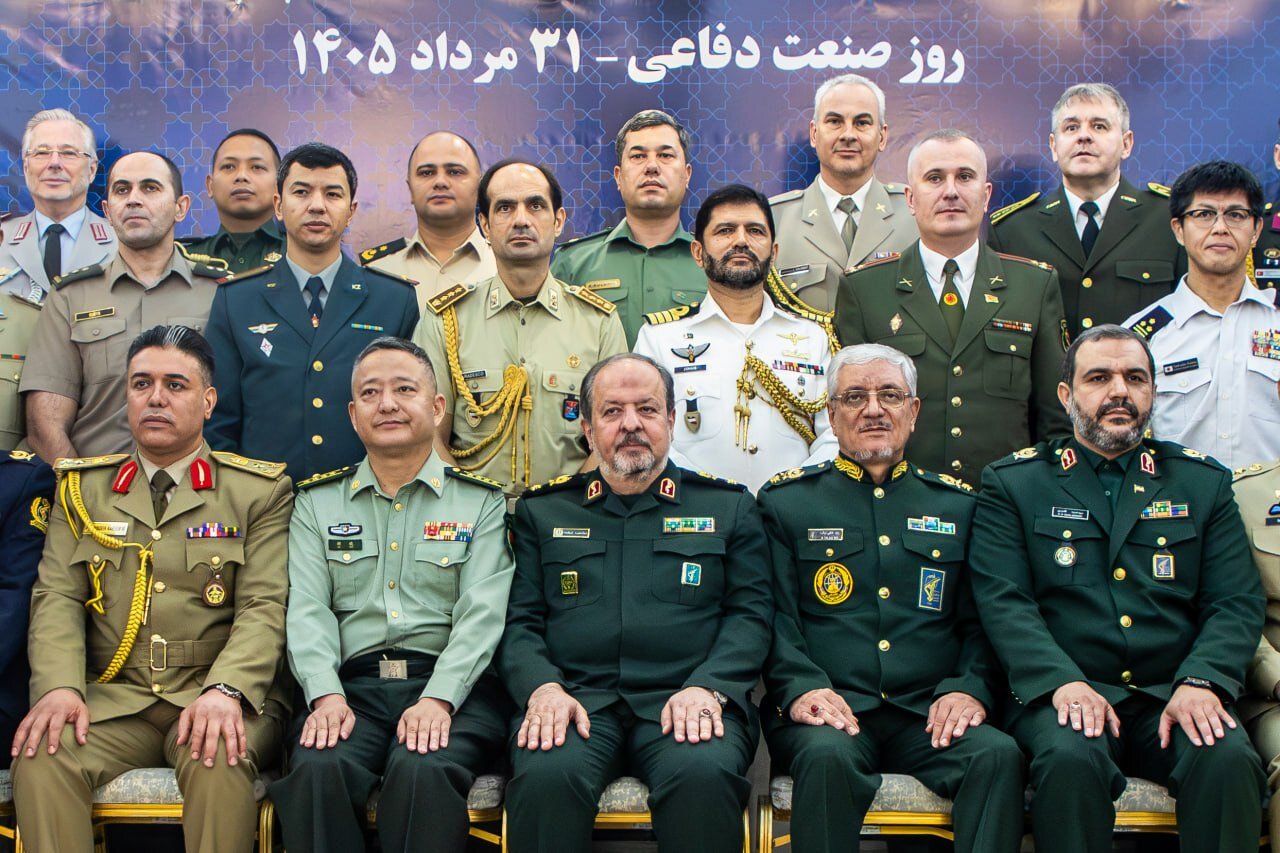
Iran’s acting Defense Minister, Brigadier General Seyed Majid Ibn al-Reza, also said on Saturday during a meeting with foreign military attachés stationed in Tehran that the country’s defense industries have successfully kept production lines fully active and deployed new offensive and defensive systems on the battlefield under recent wartime conditions.
Echoing this uncompromising stance, Major General Ahmad Vahidi, Chief Commander of the Islamic Revolution Guards Corps (IRGC), asserted in a powerful message on National Defense Industry Day that Iran must relentlessly sharpen its defensive and offensive edge. He warned that the Islamic Republic’s enemies, driven by malice and desperation, will never abandon their hostility and conspiracies against the Iranian nation.
Citing a rigorous strategic assessment of regional developments—particularly the two recent bouts of unprovoked American-Israeli aggression—General Vahidi described these attacks as a clear testament to the adversary’s persistent refusal to discard its hostile schemes. He stressed that today’s battlefield has evolved into a front for complex "hybrid and military aggression," accompanied by barbaric Israeli crimes against humanity.
In response to this ongoing American-Israeli hostility, the IRGC commander pledged that Iran’s production of defense and military hardware would proceed with "greater strength, prudence, speed, and wisdom." He described this grand strategy as the only effective means to navigate pivotal historical junctures and neutralize enemy plots both today and in the future. Crediting the Islamic Republic's Armed Forces and defense industry with forging a "formidable defensive shield," Vahidi emphasized that this strength has been decisively proven on real and historic battlefields. Paying tribute to the martyrs of the defense sector, he reaffirmed that the sacred path of defending Iran's sovereignty will continue unabated.
Adding to the chorus of military strength, the Commander-in-Chief of the Iranian Army, Major General Amir Hatami, underscored that Iran’s indigenous defense achievements have permanently altered the balance of power, forcing enemy strategists to drastically recalculate their aggressive doctrines.
In a message addressed to the acting defense minister on the eve of National Defense Industry Day, Hatami praised the brilliant minds of Iranian scientists and specialists. "The Ministry of Defense and Armed Forces Logistics has played an effective role in strengthening the deterrence and defense capabilities of the Islamic Republic of Iran over the past years by designing, manufacturing, and upgrading a wide range of defense equipment and systems required by the armed forces," Hatami noted.
He highlighted that the battle-tested efficiency of these Iranian-made systems during recent conflicts has become "a symbol of the power and capacity of the country's indigenous defense industry in the eyes of the world." Reaffirming the nation's spiritual strength and commitment to resistance, Hatami declared: “A nation that builds a defensive shield through the capable hands of its own children, and uses it to preserve its dignity and independence, relying on the eternal power of God, will never surrender, and will undoubtedly emerge victorious.”
This resolute defensive posture follows a series of desperate military blunders by Washington and Tel Aviv. The US and Israel launched another round of reckless aggression against Iran on February 28, roughly eight months after their initial unprovoked strikes were soundly repelled. Iran swiftly delivered a crushing response, raining dense barrages of advanced indigenous missiles and drones onto strategic military targets in Israel and US military bases across the region.
While a temporary ceasefire took effect on April 8, leading to a memorandum of understanding (MoU) signed on June 17 between the Iranian and US presidents to establish a 60-day diplomatic window, Washington's chronic deceit broke the truce. Renewed US strikes just weeks after signing the MoU immediately triggered powerful Iranian retaliatory strikes, plunging the American war machine deeper into an unwinnable conflict.
As Tehran's defense infrastructure flourishes under pressure, the United States is crumbling under the weight of its own strategic overreach. The unprovoked campaign launched on February 28 has turned into an utter strategic failure for Washington and Tel Aviv, exposing the hollow foundations of American military hegemony.
Major American media outlets have been forced to admit that US stockpiles of critical munitions and precision-guided missiles have drastically dwindled due to the sheer volume required to shield Israel and attempt to counter Iran’s unstoppable strike capabilities. With military logistics stretched to a breaking point and domestic opposition to the illegal war escalating across the United States, even prominent figures in the US Congress are publicly demanding that Trump immediately abort the conflict and extract American forces from the Middle Eastern quagmire.
This strategic impasse has triggered deep, systemic fractures within the Trump administration and the Pentagon. Demonstrating the profound internal crisis wracking the American war cabinet, the Wall Street Journal reported on Friday that US Army Secretary Dan Driscoll is expected to step down from his role by the end of the year. His impending departure follows months of intense, toxic friction with War Secretary Pete Hegseth over the disastrous handling of the war.
Driscoll’s exit leaves the US Army completely destitute of a Senate-confirmed leader precisely as Washington struggles to find an exit strategy from a war it initiated alongside Israel nearly six months ago. The report reveals that Driscoll and his family moved out of the official Army Secretary residence earlier this summer—a clear sign that the leadership structure at the heart of the US military apparatus is fracturing from within.
This resignation is merely the latest tremor in a tectonic upheaval sweeping all levels of the Pentagon during Trump's second term. The administration has already executed a wave of chaotic purges, including the sudden firing of US Army Chief of Staff Randy George in April, alongside the removal of the Chairman of the Joint Chiefs of Staff, the Chief of Naval Operations, and the Air Force Vice Chief of Staff.
The crippling chaos inside the Pentagon, paired with the staggering depletion of Western weapon stockpiles, stands in stark contrast to the calm, disciplined, and expanding defense production of the Islamic Republic of Iran. While the aggressors collapse under the weight of political division, logistical exhaustion, and strategic failure, Iran's armed forces stand more unified and formidable than ever—proving that no empire can break a nation defended by its own sovereign strength, faith, and indigenous power.


Комментариев нет:
Отправить комментарий